Ggplot X Axis Label With Breaks Continuous
This article describes how to easily set ggplot axis ticks for both x and y axes. We'll also explain how to rotate axis labels by specifying a rotation angle.
In this R graphics tutorial, you will learn how to:
- Change the font style (size, color and face) of the axis tick mark labels.
- Rotate axis text labels. For example, for a vertical x axis text label you can specify the argument angle as follow:
p + theme(axis.text.x = element_text(angle = 90)). - Remove axis ticks mark and text:
p + theme(axis.text.x = element_blank(), axis.ticks = element_blank()). - Remove grid lines and customize axis lines.
- Customize axis ticks for discrete and continuous axes:
- Manually label / rename tick marks and change the order of items in the plot for a discrete x axis.
- Format continuous axis tick labels using
percent,dollarandscientificscale transformations. - Change the axis ticks interval (or breaks) by specifying custom values.
Contents:
- Key ggplot2 R functions
- Example of plots
- Change axis tick mark labels
- Remove x and y axis tick mark labels
- Change axis lines
- Customize continuous and discrete axes
- Discrete axes
- Continuous axes
- Conclusion
Key ggplot2 R functions
- Main functions:
The following function will be used to modify the axis theme and scale:
- theme(axis.text.x = element_text(), axis.text.y = element_text()). Change the appearance of axes text.
- theme(axis.line = element_line()). Change the axis lines
- scale_x_discrete() and scale_y_discrete(). Customize discrete x and y axes, respectively.
- scale_x_continuous() and scale_y_continuous(). Customize continuous x and y axes, respectively.
The scale functions take the arguments breaks, labels and limits as inputs.
- Key ggplot2 theme options to modify the axis line, axis ticks and tick text labels:
theme( # Change axis lines axis.line = element_line(), # Change axis ticks text labels: font color, size and face axis.text = element_text(), # Change tick labels for all axes axis.text.x = element_text(), # Change x axis tick labels only axis.text.x.top = element_text(), # x axis tick labels on top axis axis.text.y = element_text(), # Change y axis tick labels only axis.text.y.right = element_text(),# y axis tick labels on top axis # Change axis ticks line: font color, size, linetype and length axis.ticks = element_line(), # Change ticks line fo all axes axis.ticks.x = element_line(), # Change x axis ticks only axis.ticks.y = element_line(), # Change y axis ticks only axis.ticks.length = unit(3, "pt") # Change the length of tick marks ) Arguments of the helper functions:
-
element_text(color, size, face, family, angle, hjust, vjust). Modify the appearance and the rotation angle of axis texts. -
element_line(color, size, linetype). Modify the appearance of line elements. -
unit(). Change axis ticks length. Example: unit(4, "pt").
To remove a particular axis text or ticks, use element_blank() for the corresponding theme argument. For example to remove all axis ticks, use this: p + theme(axis.ticks = element_blank()).
Example of plots
Start by creating a box plot using the ToothGrowth data set:
library(ggplot2) p <- ggplot(ToothGrowth, aes(x = factor(dose), y = len)) + geom_boxplot() p 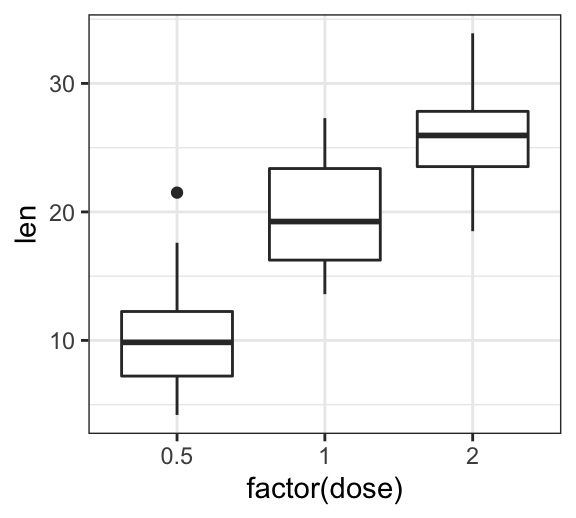
Change axis tick mark labels
The functions theme() and element_text() are used to set the font size, color and face of axis tick mark labels. You can also specify the argument angle in the function element_text() to rotate the tick text.
Change the style and the orientation angle of axis tick labels. For a vertical rotation of x axis labels use angle = 90.
# Rotate x and y axis text by 45 degree # face can be "plain", "italic", "bold" or "bold.italic" p + theme(axis.text.x = element_text(face = "bold", color = "#993333", size = 12, angle = 45), axis.text.y = element_text(face = "bold", color = "blue", size = 12, angle = 45)) # Vertical rotation of x axis text p + theme(axis.text.x = element_text(angle = 90)) 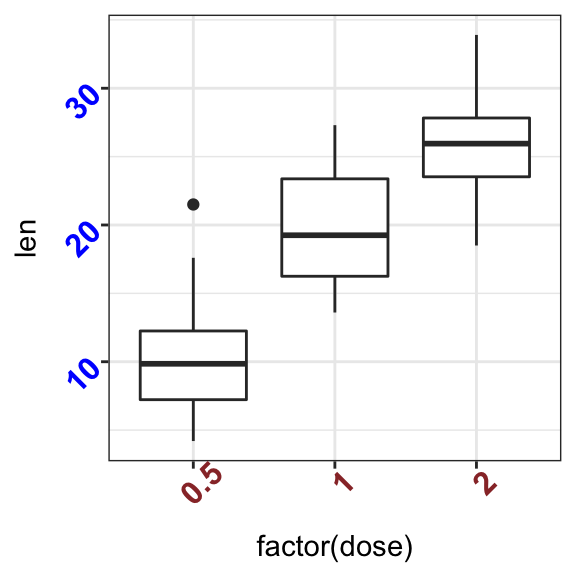
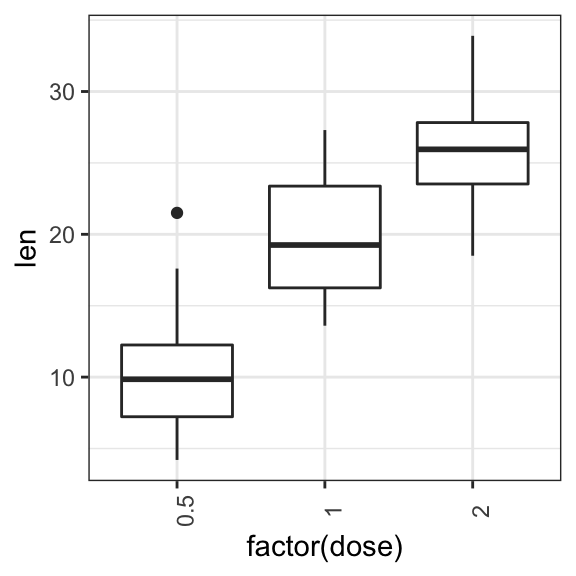
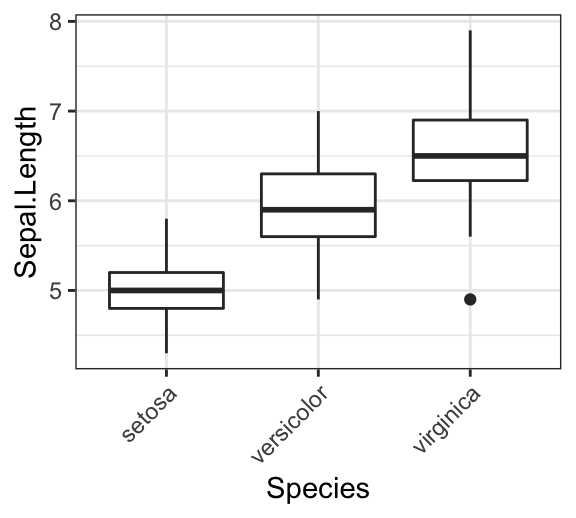
To adjust the position of the axis text, you can specify the argument hjust and vjust, which values should be comprised between 0 and 1. For example:
# Create a new simple box plot p2 <- ggplot(iris, aes(Species, Sepal.Length)) + geom_boxplot() # Rotated but not adjusted x axis text p2 + theme(axis.text.x = element_text(angle = 45)) # Rotate and adjust x axis text p2 + theme(axis.text.x = element_text(angle = 45, hjust = 1)) 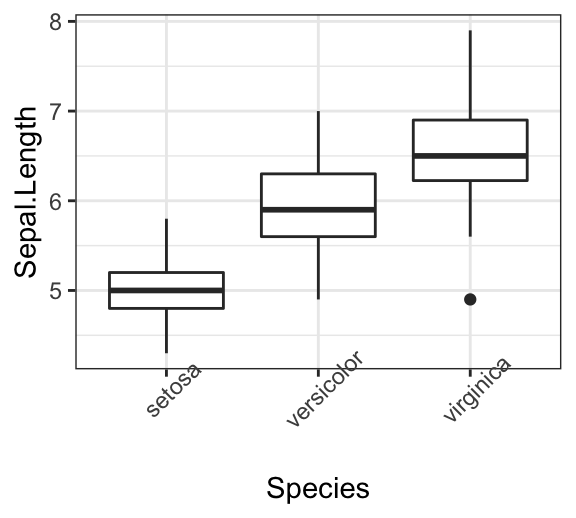
Remove x and y axis tick mark labels
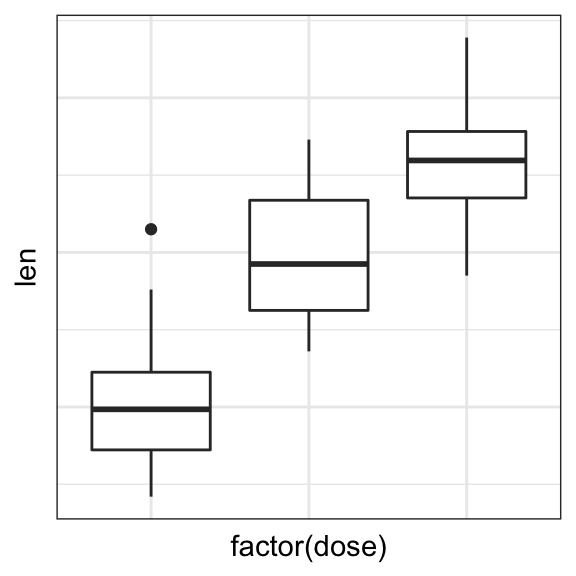
Key function: element_blank()
# Remove x and y axis tick mark labels p + theme( axis.text.x = element_blank(), axis.text.y = element_blank()) # Remove axis ticks and tick mark labels p + theme( axis.text.x = element_blank(), axis.text.y = element_blank(), axis.ticks = element_blank()) 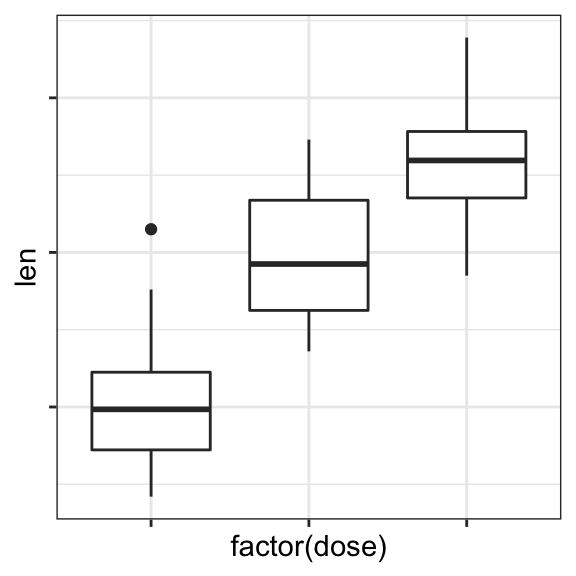
Change axis lines
- Key function:
theme()andelement_line() - Allowed values for line types: ("blank", "solid", "dashed", "dotted", "dotdash", "longdash", "twodash") or number (0, 1, 2, 3, 4, 5, 6).
linetype = "solid"is identical tolinetype = 1.
Change the color, the size and the line type of axis lines:
p + theme( axis.line = element_line(color = "darkblue", size = 1, linetype = "solid") ) 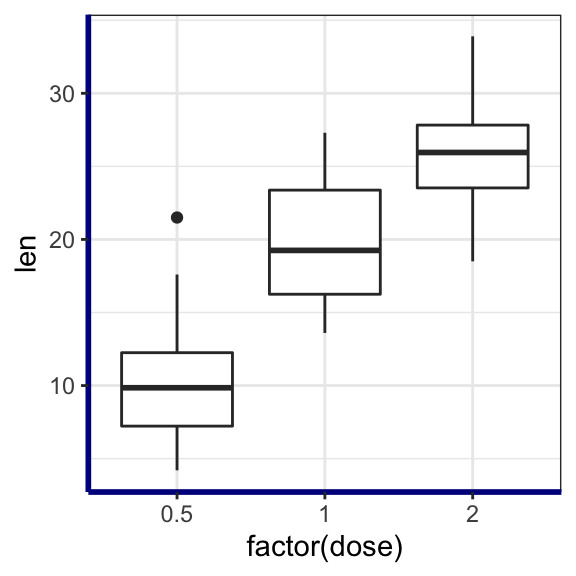
Customize continuous and discrete axes
x or y axis can be discrete (grouping variable) or continuous (numeric variable). In each of these two cases, the functions to be used for setting axis ticks are different.
Key ggplot2 R functions:
- Discrete axes:
- scale_x_discrete(name, breaks, labels, limits): for x axis
- scale_y_discrete(name, breaks, labels, limits): for y axis
- Continuous axes:
- scale_x_continuous(name, breaks, labels, limits, trans): for x axis
- scale_y_continuous(name, breaks, labels, limits, trans): for x axis
Function arguments definition:
-
name: x or y axis labels -
breaks: vector specifying which breaks to display -
labels: labels of axis tick marks -
limits: vector indicating the data range
The scale_xx() functions can be used to change the following x or y axis parameters :
- axis titles or labels
- axis limits (data range to display)
- choose where tick marks appear
- manually label tick marks
Discrete axes
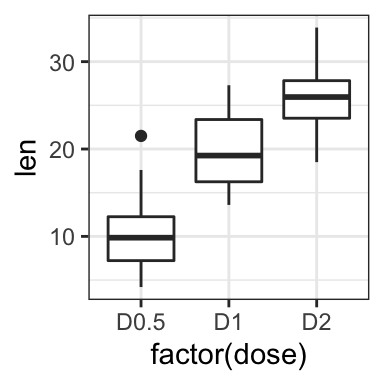
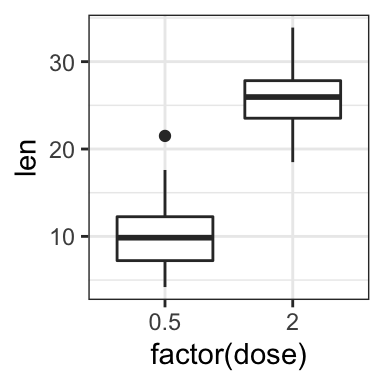
In the examples below, we'll use only the functions scale_x_discrete() and xlim() to customize x axis tick marks. The same type of examples can be applied to a discrete y axis using the functions scale_y_discrete() and ylim().
# Change x axis label and the order of items p + scale_x_discrete(name ="Dose (mg)", limits=c("2","1","0.5")) # Rename / Change tick mark labels p + scale_x_discrete(breaks=c("0.5","1","2"), labels=c("D0.5", "D1", "D2")) # Choose which items to display p + scale_x_discrete(limits=c("0.5", "2")) # or use this: # p + xlim("0.5", "2") # same as above 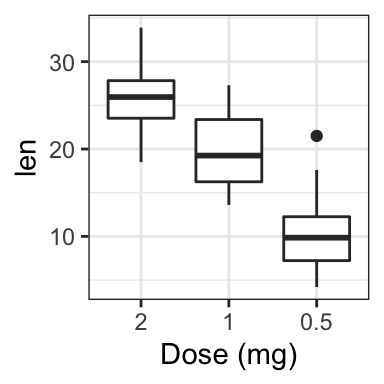
Continuous axes
- Create a simple scatter plot
- Change axis labels and limits. Break axis by a user defined value.
# Simple scatter plot sp <- ggplot(cars, aes(x = speed, y = dist)) + geom_point() sp # Change x and y axis labels, and limits sp + scale_x_continuous(name="Speed of cars", limits=c(0, 30)) + scale_y_continuous(name="Stopping distance", limits=c(0, 150)) 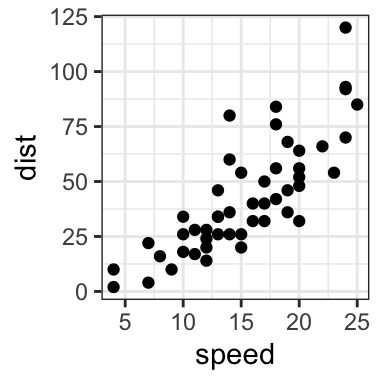
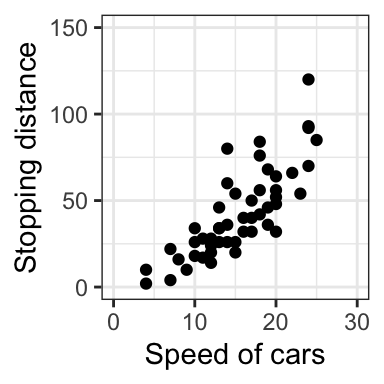
- Change axis ticks interval:
# Break y axis by a specified value # a tick mark is shown on every 50 sp + scale_y_continuous(breaks=seq(0, 150, 50)) # Tick marks can be spaced randomly sp + scale_y_continuous(breaks=c(0, 50, 65, 75, 150)) 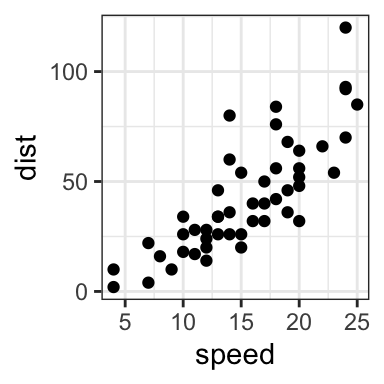
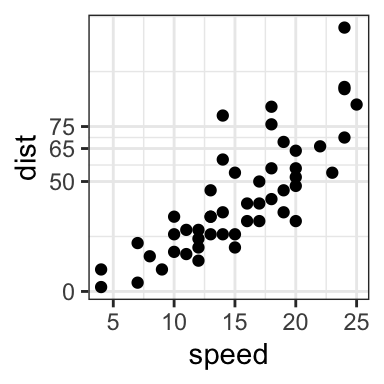
- Remove tick mark labels and gridlines
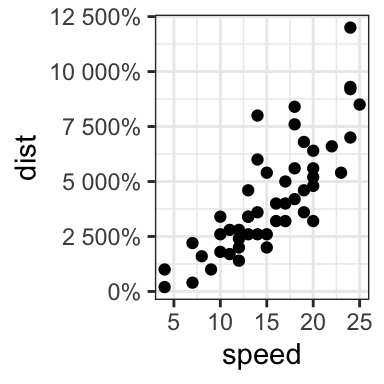
- Format axis tick labels. Possible values for labels are comma, percent, dollar and scientific. For more examples, read the documentation of the function trans_new() in the
scalesR package.
# Remove y tick mark labels and grid lines sp + scale_y_continuous(breaks=NULL) # Format y axis labels in percent (%) require(scales) sp + scale_y_continuous(labels = percent) 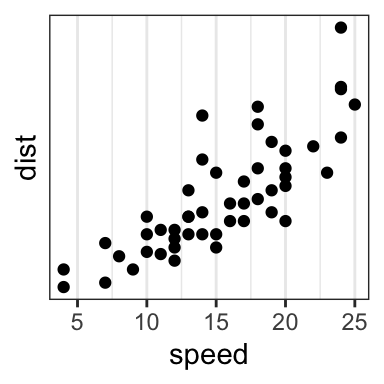
For dollar and scientific formats, type this:
require(scales) # Dollar p + scale_y_continuous(labels = dollar) # Scientific p + scale_y_continuous(labels = scientific) Conclusion
- Create an example of ggplot:
library(ggplot2) p <- ggplot(iris, aes(Species, Sepal.Length)) + geom_boxplot() - Change tick font:
# Change tick text for both x and y axis p + theme( axis.text = element_text(size = 11, color = "blue") ) # Change tick text for x axis ony p + theme(axis.text.x = element_text(color = "blue", face = "italic")) - Rotate x axis text:
# Vertical rotation: 90 degree p + theme( axis.text.x = element_text(angle = 90, hjust = 1, vjust = 0.5) ) # Rotate by 45 degree p + theme( axis.text.x = element_text(angle = 45, hjust = 1) ) - Remove x axis ticks and rename tick labels:
p + theme(axis.ticks.x = element_blank())+ scale_x_discrete( breaks=c("setosa","versicolor","virginica"), labels=c("SE", "VE", "VI") ) Recommended for you
This section contains best data science and self-development resources to help you on your path.
Version:  Français
Source: https://www.datanovia.com/en/blog/ggplot-axis-ticks-set-and-rotate-text-labels/
0 Response to "Ggplot X Axis Label With Breaks Continuous"
Post a Comment